Here’s the deal with your pitching wedge because it connects your short game to your iron set, but the specs are always changing. While traditional sets usually fixed the pitching wedge at 47 to 48 degrees, many modern clubs crank that loft down closer to 43 to 45 degrees. If you are wondering what degree a pitching wedge is and how far it should go, you need more than a guess. Typically, a solid strike carries this club around 110 to 130 yards for men and 70 to 90 yards for women, though your real distance largely depends on your specific club. Let’s dial in your numbers so you can start hitting more consistent greens.
Modern vs. Traditional: What Degree is A Pitching Wedge?
To understand your pitching wedge, we should look at how club manufacturing is evolving over the years.
The Traditional Blueprint
A couple of decades ago, golf sets were highly standardized. If you bought a traditional set of irons, the pitching wedge was almost always 47 or 48 degrees. It provided a high, soft-landing ball flight that sat perfectly between your 9-iron and your sand wedge.
The Modern "Strong Loft" Trend
If you bought a distance-focused iron set recently, the guidelines on specs are completely different. Brands frequently design irons with stronger lofts and lower centers of gravity to help everyday golfers launch the ball further with less effort. As a result, modern pitching wedges often check in closer to 43 to 45 degrees.
Here is a quick breakdown of where standard pitching wedge lofts usually sit across popular modern golf iron categories:
Iron Set Category
Typical PW Loft
Real-World Examples
Traditional Blades
46° – 48°
Titleist 620 MB / Mizuno Pro 241
Players Distance
44° – 45°
TaylorMade P790 / Callaway Apex
Game Improvement
43° – 44°
Callaway Paradym Ai Smoke / TaylorMade Qi
Super Game Improvement
41° – 42°
Cleveland ZipCore XL / Ping G730
If your pitching wedge happens to be 43 degrees, it flies a lot like an old-school 9-iron. This means you will likely hit it significantly further, but it also means you might accidentally create a massive distance gap between your pitching wedge and your next highest lofted wedge.
How Far Should Your Pitching Wedge Go?
Once you know your loft, the next question is obvious: How far should it fly?
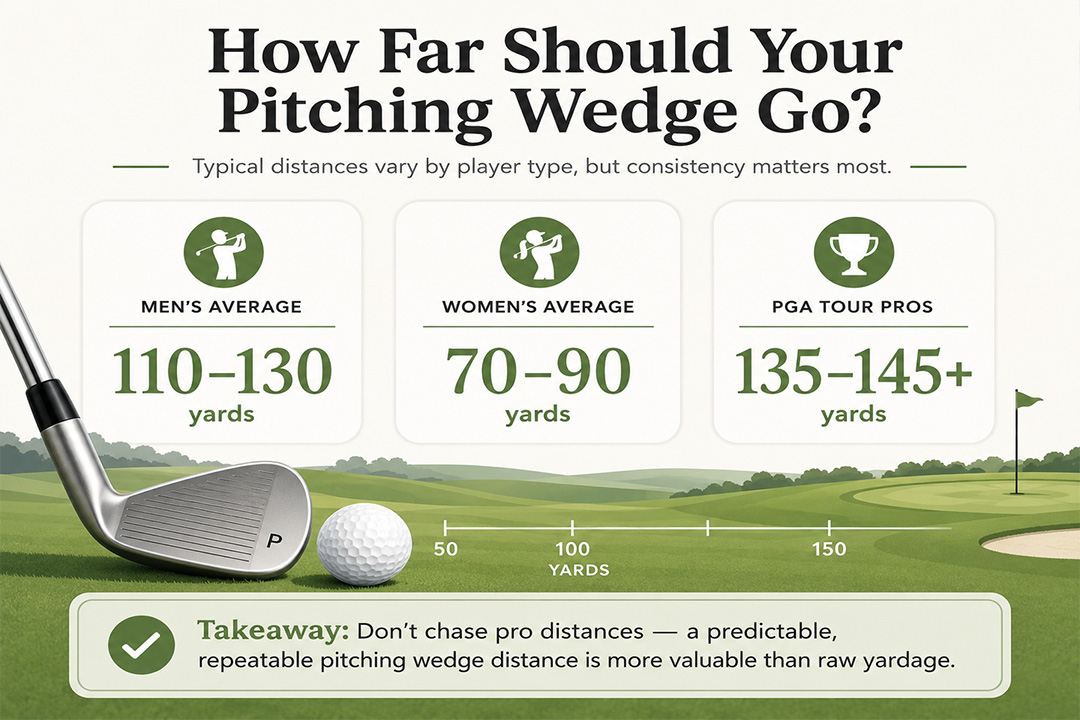
There is no single "correct" distance in golf, as yardage frequently depends on your swing speed, quality of strike, and even the weather conditions on the fairway. However, we can look at real-world averages to see where you stack up:
Men's Average: 110 – 130 yards
Women's Average: 70 – 90 yards
PGA Tour Pros: 135 – 145+ yards
Instead of chasing the distances you see the pros hit on TV, your ultimate goal should be consistency. Knowing that your pitching wedge goes a predictable distance most of the time is much more valuable than hitting one random shot 130 yards and blading the next one over the green.
Pitching Wedge vs. Other Wedges: The Loft Breakdown
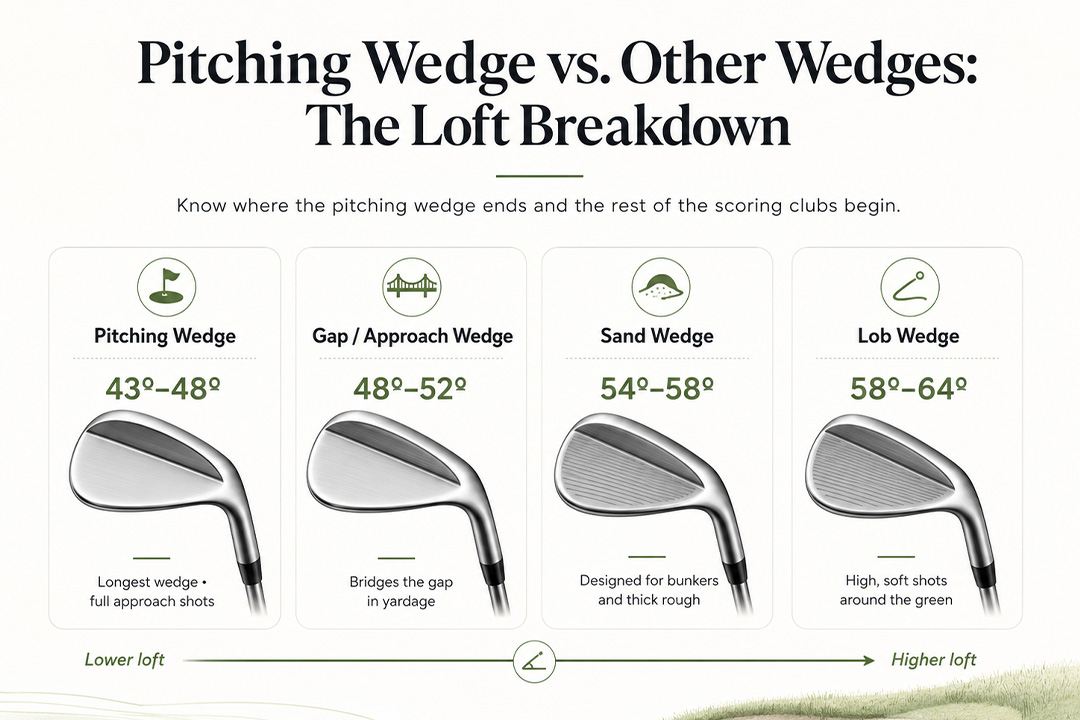
To manage your course strategy effectively, you should know where the pitching wedge stops and the rest of your scoring clubs begin. Here is how the complete wedge family usually shakes out across the bag:
Pitching Wedge (43° – 48°): This is the longest wedge in your bag. It is primarily used for full approach shots into the green and basic bump-and-run chips on the fairway.
Gap / Approach Wedge (48° – 52°): True to its name, this club frequently bridges the specific yardage gap between your pitching wedge and sand wedge.
Sand Wedge (54° – 58°): Featuring a wider sole and heavier bounce, it is explicitly designed to glide smoothly through greenside bunkers and heavy, thick rough.
Lob Wedge (58° – 64°): The ultimate short-game weapon, often used for throwing the ball high into the air to stop it quickly on tight greens.
Mastering the PW Swing for Consistent Yardage
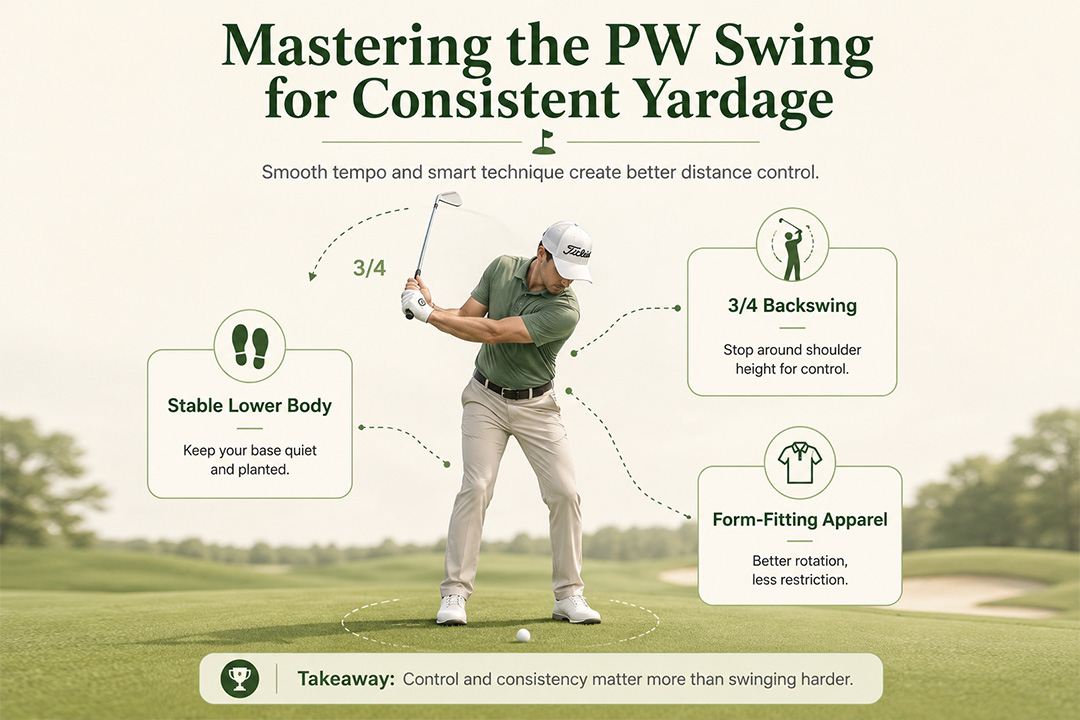
Unlike your driver, where the goal is often to swing as fast as possible, the pitching wedge requires a smooth and controlled tempo to protect your accuracy. To lock in that perfect yardage and stop missing greens, you should focus on these essential short-game techniques:
Maintain a Stable Lower Body
A solid strike right on the sweet spot always starts with a quiet foundation from the waist down. You want to keep your feet planted and allow the natural weight of the club head to slide cleanly through the turf rather than trying to force extra distance with a violent body shift.
Dial in a Shorter Three-Quarter Backswing
Trying to take a massive full swing with a pitching wedge frequently leads to a chunked or bladed shot that flies way over the green. Instead, practice stopping your backswing when your hands reach shoulder height, which naturally delivers a more predictable trajectory and much tighter distance control.
Choose Form-Fitting Apparel for Better Rotation
Your upper body must rotate completely without any physical friction, meaning that the fit of your clothing is actually a crucial piece of your short-game equipment. A baggy, stiff, or restrictive shirt can easily snag during your turn and disrupt your swing path at the worst possible moment.
Heritage Stripe Polo
Ocean Camo Polo
Building Your Wedge Matrix: What Comes Next?
Knowing your current pitching wedge loft is the essential foundation for a proper short-game setup. To avoid a "dead zone" in your distances where you don't have a matching club, you should follow these three simple steps to optimize your wedge spacing:
Step 1: Check Your Current Pitching Wedge Loft – Visit your club manufacturer's website or visit a local golf shop to find your exact numbers, as modern pitching wedges typically range anywhere from 43 to 48 degrees.
Step 2: Apply the Four-Degree Rule – Maintain roughly 4 to 6 degrees of separation between each of your scoring clubs to ensure you do not leave any massive 20-yard gaps in your short game.
Step 3: Choose Your Ideal Scoring Setup – Depending on your iron model, your golf bag will frequently fall into one of these two common matrix combinations:
The Traditional Matrix (PW at 47°): Your ideal progression usually includes a 52-degree gap wedge and a 56-degree sand wedge.
The Modern Distance Matrix (PW at 44°): You will likely need a stronger gap wedge around 48 or 49 degrees before moving on to your 54-degree and 58-degree wedges.
Conclusion
At the end of the day, lower scores usually start with confidence. Once you verify your pitching wedge loft and lock in your true yardages, you can eliminate a lot of the guesswork that causes bad chips. From there, you just need to step up, look sharp, and commit to your swing. When you feel good about both your stats and your style, better rounds frequently follow. If you are ready to match your short game with a fresh fairway look, head over to the Deolax New Arrivals Collection to grab some high-stretch, moisture-wicking golf gear designed to move naturally with your body. Trust your numbers, trust your swing, and enjoy the game.
You can definitely chip with a pitching wedge, and it is actually one of the safest shots you can play around the green. It is perfect for a basic bump-and-run because the lower loft gets the ball rolling quickly, like a putt. This gives you a much bigger margin for error than trying to flop it with a risky lob wedge.
Is a 45-degree wedge a pitching wedge?
Yes, it absolutely is, so don't worry if that loft sounds a bit low. Most modern golf brands design their newer iron sets with stronger lofts to help everyday players get some extra distance. Seeing a 45-degree pitching wedge in a modern set is completely normal today.
What club replaces a pitching wedge?
If you lose your pitching wedge, your best bet is to grab your 9-iron and choke down on the grip a little bit. If you make a smooth, controlled three-quarter swing instead of a full lash, you can usually match that exact wedge distance perfectly. Just expect the ball to roll out slightly more once it hits the green.